You cleaned it up right away. You blotted, sprayed, and blotted again. The spot looks fine.
Then a humid day rolls around, or the furnace kicks on, and that smell is back.
If you have pets in McHenry County, you are not alone. Pet urine is one of the most common problems we see in carpet, and it is also one of the most misunderstood. The stain you can see is usually the smallest part of it.
Why Pet Urine Is Different From Other Spills
Most spills sit near the top of the carpet. Urine does not stay there. It soaks through the carpet fibers, passes through the backing, and spreads out into the pad underneath. In some cases it reaches the subfloor.
Underneath the carpet, the spot is almost always bigger than it looks on top. A stain the size of a coaster on the surface can be the size of a dinner plate in the pad.
As urine dries, it leaves behind salts and other residue. Those salts pull moisture out of the air, which is why the odor tends to come back on humid days or after the carpet gets damp. Over time, bacteria break the residue down further, and the smell gets stronger rather than fading.
Why Surface Cleaning Usually Falls Short
Store-bought sprays and rental machines work on the face of the carpet. They can make the top of a spot look clean, but they do not reach the pad where most of the urine is sitting.
Some common habits can actually make things worse:
- Too much water. Pouring water or cleaner on the spot pushes the urine deeper and spreads it wider in the pad.
- Heat. Steam or hot water on an untreated urine spot can set the odor and the stain.
- Ammonia-based cleaners. Urine already contains ammonia compounds, so these can smell like a familiar spot to your pet.
- Scrubbing hard. Aggressive scrubbing can untwist and fuzz the carpet fibers without reaching the source.
There is also a pet problem with leftover odor. Dogs and cats have far better noses than we do. If they can still smell an old spot, they are more likely to go back to it.
What Professional Pet Urine Treatment Does Differently
Good pet urine treatment starts with finding every spot, not just the ones you know about. At Clean Bee, that process looks like this:
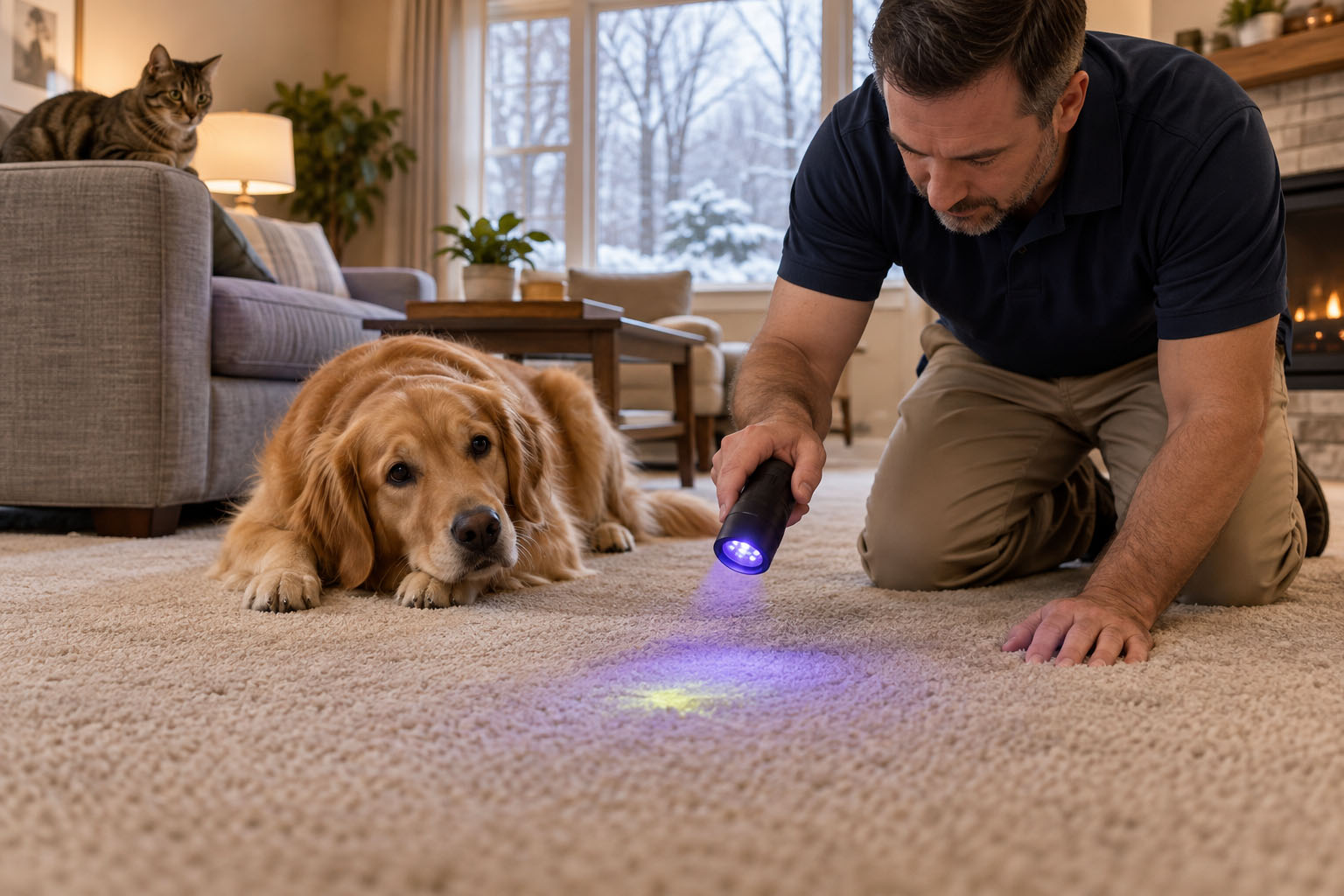
- Find it. A UV black light shows urine deposits that are invisible in normal light, including old ones.
- Measure it. A moisture meter shows how far each spot has spread under the carpet, so the treatment covers the whole area and not just the visible stain.
- Treat it. A treatment solution is applied to saturate the carpet and the pad, then left to dwell so it can work on the residue.
- Pull it out. A sub-surface extraction tool pulls the solution and urine up from the pad instead of leaving it underneath.
- Rinse it. A low-pH rinse finishes the area so it is not left sticky or residue-heavy.
In most homes, this lets us take care of the problem without pulling up the carpet.
What Cleaning Can Fix, and What It Can’t
We would rather be honest with you up front.
Professional treatment handles the large majority of pet urine problems, especially when the spots are treated before they have been soaking for months. Odor, staining, and the residue that keeps drawing pets back can usually be corrected.
There are a few situations where cleaning alone is not the whole answer:
- Color loss. Urine can bleach or change the color of carpet fibers. Once the dye is gone, cleaning cannot put it back. Spot carpet dyeing can often blend the area back in.
- Physical damage. If a pet has chewed, scratched, or dug at the spot, carpet repairs can patch or re-stretch the area.
- Long-term, heavy saturation. When the same spot has been used for a long time, urine can soak into the wood subfloor. In those cases, part of the pad may need to be replaced or the subfloor sealed. A good technician will tell you that before starting, not after.
Winter in Northern Illinois Makes Accidents More Likely
Once the cold settles in around McHenry, Lakemoor, and Crystal Lake, pets spend more time indoors. Older dogs do not want to go out in the snow, puppies are harder to house-train when the yard is frozen, and cats may skip a litter box that is in a cold basement.
Closed-up winter homes also hold onto odors. With the windows shut and the furnace running, a smell that was barely noticeable in September can be hard to miss by January.
That makes fall a smart time to get existing spots treated, before holiday guests arrive and before winter adds new ones.
What to Do When an Accident Happens
Quick action makes professional treatment easier and more effective. When you find a fresh spot:
- Blot up as much as you can with plain white paper towels or a white cloth, pressing firmly.
- Do not soak the area with water or cleaner.
- Skip heat, steam, and ammonia-based products.
- Make a note of where it happened, so it can be checked later.
For a spill that is not pet-related, our spot removal service can help as well.
Odor Is Not Always Only in the Carpet
Pets leave traces in more than one place. If the house still smells like pets after the carpet is treated, the source may be the couch, a favorite chair, an area rug, or even the air ducts. Our post on why a clean-looking home can still feel stale walks through the other places odors hide, and upholstery cleaning and area rug cleaning can take care of the rest of the room.
Once the spots are treated, a fabric protector can make future accidents easier to clean up. We explain how that works in protecting your carpet and furniture before winter.
Get Your Home Smelling Like Home Again
You love your pets. You do not have to love the smell.
If you have spots that keep coming back, or a room that never quite smells fresh, Clean Bee can find the source and treat it properly. We have been helping families in McHenry County and northern Lake County since 2005.
Call us at (815) 578-0233 or request a free estimate for professional pet urine treatment. Your nose, and your pets, will thank you.